

WEGE PRIZE 2019 WINNERS
1ST PLACE - REDENT
Priscilla Oluwakemi Badusi U
Chemistry
Wellesley College (United States)
Aisha Muhammed Balogun U
Computer Engineering
University of Wyoming (United States)
Mukhtar Hamzat U
Electrical and Electronic Engineering
Ashesi University (Ghana)
Fatimah Owolabi U
Entrepreneurship
African Leadership University (Rwanda)
Ohagwu Collins Patrick U
Agricultural Sciences
EARTH University (Costa Rica)
Click above image to access the full Project Summary
Solution Overview
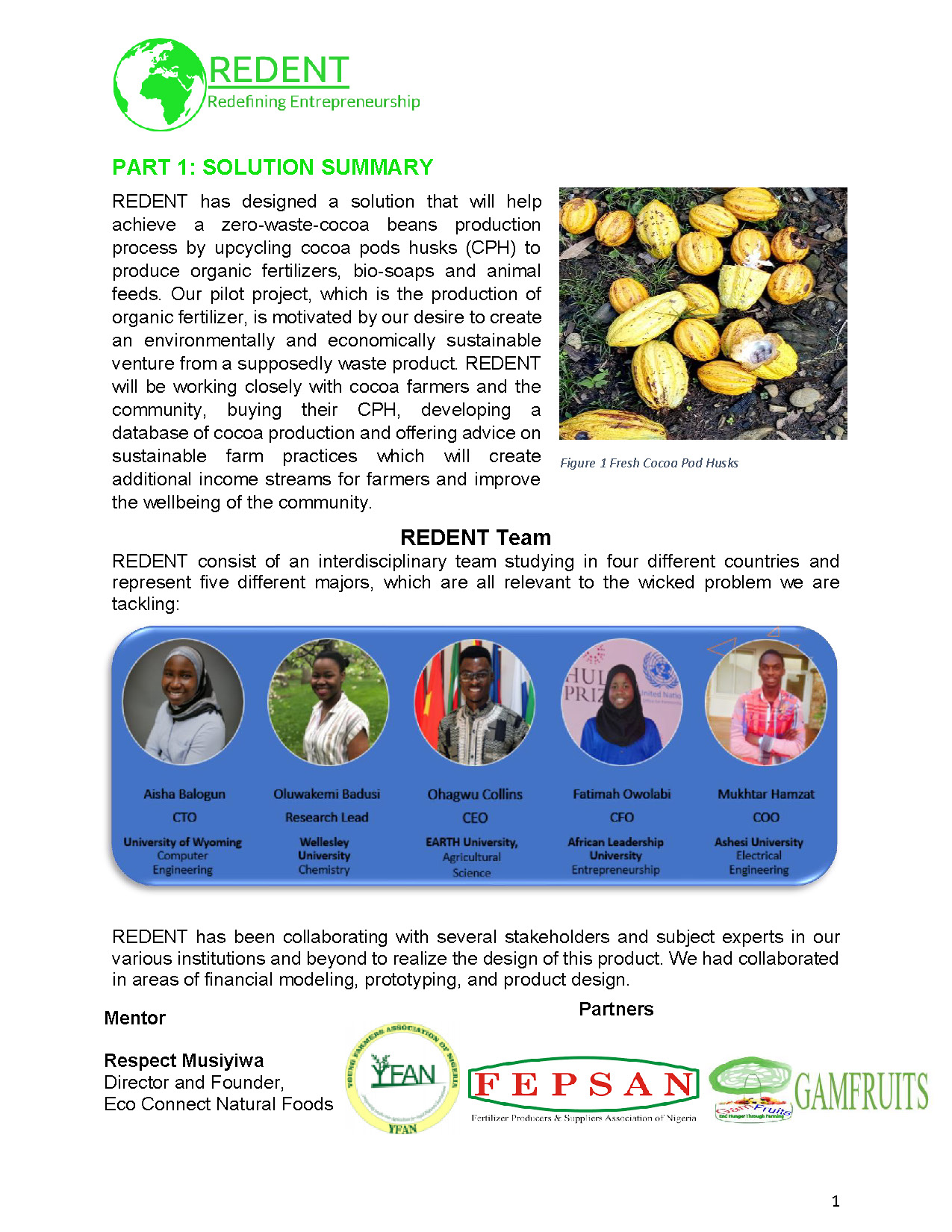
REDENT has designed a solution that will help achieve a zero-waste-cocoa beans production process by upcycling cocoa pods husks (CPH) to produce organic fertilizers, bio-soaps and animal feeds.
2ND PLACE - CONSIDERED FURNITURE
Jack Cottrell U
Biology
University of Toronto (Canada)
Joe Dunaske U
Collaborative Design/Furniture Design
Kendall College of Art and Design of Ferris State University (United States)
Kate Hyman U
Furniture Design
Kendall College of Art and Design of Ferris State University (United States)
Sydney Johnson G
Architecture
Kendall College of Art and Design of Ferris State University (United States)
Lindsey Maner U
Furniture Design
Kendall College of Art and Design of Ferris State University (United States)

Click above image to access the full Project Summary
Solution Overview
Considered Furniture planned to provide attainably priced sustainable furniture, designed to be fully biodegradable. They offer customizable suites of furniture, encompassing the entirety of living space needs. Buy-back credit and pricing incentives drive consumers to return their product at the end of their use for remanufacture, participating in a circular system.
3RD PLACE - WET TECHNIK
Melissa Mukama Buzabo U
Industrial and Fine Arts
Makerere University School of Art and Technology (Uganda)
Mark Musinguzi U
Mechanical Engineering
Makerere University School of Engineering (Uganda)
Emmanuel Musumba U
Mechanical Engineering
Makerere University School of Engineering (Uganda)
Shatsi Mwebesa U
Quantity Surveying
Makerere University School of Built Environment (Uganda)
Dennis Ssekimpi U
Civil Engineering
Makerere University School of Engineering (Uganda)

Click above image to access the full Project Summary
Solution Overview
Wet Technik is a student start-up founded at Makerere University by a multidisciplinary group of students looking at reducing the costs of water usage and environmental pollution by hazardous wastewater through the use of constructed wetlands. Focused on solving the ever-present problem around wastewater handling, they want to bring to light the potential of its recycling to enable optimum water usage. Through using a mixture of modified waste bottle caps and pumice in their constructed wetland, they have proven that it will reduce the area requirements, making this system accessible to the factories, schools and eventually households.