
New Judges Debut for Wege Prize Global Competition, Adding Expertise in Agriculture, Biomimicry
Two additions to the group of core judges expand perspective, support for remaining 150 student participants, vying for recognition of their game-changing solutions for a circular economy
The acclaimed global student competition Wege Prize has announced two esteemed additions to its diverse roster of core judges, a move that promises to help make the 13th annual iteration of the program – dedicated to promoting innovation in circular economy entrepreneurship – the most exciting and comprehensive to date.

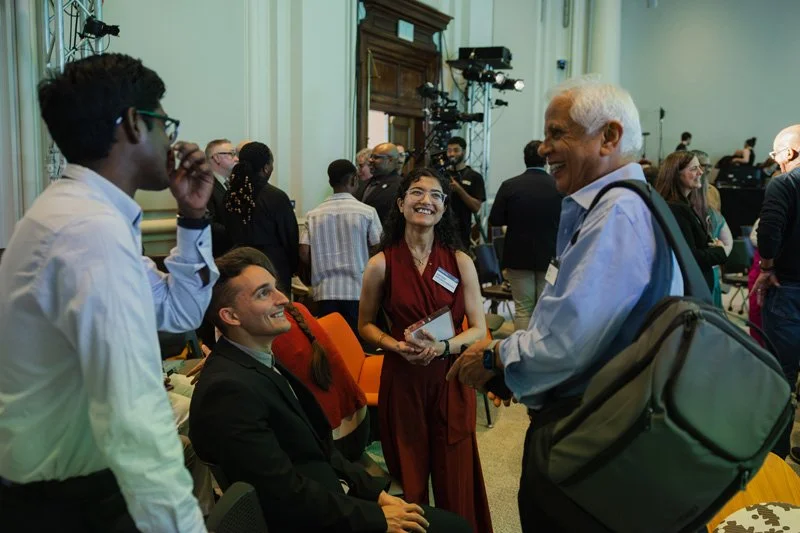
Wege Prize 2025 finalist team Envirovex connecting with judge BK Singh during the 2025 Wege Prize Awards
The 15 preliminary judges have so far narrowed an initial field of 87 teams down to 30 during the first of the competition’s four phases. Now, the group of 10 core judges will take the lead on helping the remaining teams—composed of 150 students representing 19 countries, 47 institutions of higher learning, and 85 distinct areas of academic discipline—refine their ideas for game-changing products or services that support the regenerative, restorative, and waste-free model of the circular economy.
The two new Wege Prize core judges are:
Gretchen Hooker, artist, designer, biomimicry expert, and founder of Pixel Naturalist design studio, based in Missoula, Montana and working globally.
Joaquin Viquez, an Oxford-educated social impact leader and entrepreneur, whose recent work includes novel nutrient management ideas for agriculture as founder of Innovaciones Circulares.

Gretchen Hooker

Joaquin Viquez
“These two valuable additions to our lineup of core judges enhance what makes Wege Prize unique among sustainability competitions: the vigorous synergy between the student teams and the competition’s diverse panel of professionals that accelerates the forward motion from innovative concepts to workable solutions,” says Gayle DeBruyn, professor and sustainability officer at Ferris State University’s Kendall College of Art and Design (KCAD), and a lead Wege Prize organizer. “As dedicated to a more sustainable future as they are to cultivating a new generation of solutions-oriented entrepreneurs, our judges are already shepherding the teams to refine and improve their concepts and presentations.”
Competing for a Better Future
According to DeBruyn, the input from the judges helps develop concepts for businesses that could address some of the most persistent and thorny issues of our time, including hunger, pollution, soil health, and landfill growth.
Organized by KCAD, Wege Prize invites college-level students from around the globe to collaborate in teams of five to create, develop and promote innovative solutions to “wicked problems.” From hunger and waste to pollution, climate change, homelessness and more, their real-world entrepreneurial concepts advance innovative solutions that make real and lasting change by reinforcing the future circular economy.

Charles Otieno Oyamo of Wege Prize 2025 finalist team Rethread Africa presenting at the 2025 Wege Prize Awards
The global panel of Wege Prize judges comprise a diverse and distinguished assemblage of innovators and experts. The additions of Hooker and Viquez are particularly noteworthy for complementing the existing roster with new expertise in biomimicry and in circular economy for agriculture.
As teams proceed through the remaining three competition phases, the core judges will ultimately name five finalist teams, who will present their ideas at the 2026 Wege Prize Awards this coming May and compete for a share of a $65,000 prize purse.
This year’s crop of proposals has revealed a handful of notable themes connecting teams in their pursuit of a better future:
Turning Problems into Solutions. Leveraging the untapped value of waste, several teams are attempting to solve two problems at once by transforming one problem into a solution for another, such as redirecting harmful methane emissions to become a feedstock for bioplastics.
Focus on Food. Multiple teams are tackling problems related to food production and access. For example, one team plans to create a scalable food redistribution network to move surpluses into insecure communities in Afghanistan, while upcycling food waste into compost and other uses.
Soil Stewardship Addressing soil health or lack thereof, several teams have focused on a key driver of such systemic issues as food insecurity, water access, and farming viability in agrarian societies. More than one proposal seeks to harness regional waste streams to produce organic fertilizers that promote long-term soil health.
Over the last 12 competitions, Wege Prize winners have earned over half a million dollars in total cash awards, helping promote the circular economy among the multidisciplinary, cultural, and institutional participants. But it’s not just about the winners, says DeBruyn.
“The interactive nature of a competition in which expert judges act as advocates for the competitors and their ideas produces ripple effects,” she says. “Many individuals and teams who were not finalists have gone on to be highly successful innovators and entrepreneurs, whether through incubator hubs, private business models, or academic involvement. In this way, Wege Prize’s judges have direct, tangible impact on the future of the circular economy.”