

Student teams with game-changing solutions present 15 innovative ideas for a better planet—semifinalists studying in 11 countries including Qatar, the Netherlands, Rwanda, and the United States

As Wege Prize 2026 advances 15 student teams into its semifinalist phase, the worldwide student competition for circular economy learning and innovation is illuminating the power of cooperative problem solving. This good news comes on the heels of the World Economic Forum’s recent announcement that geoeconomic confrontation is the top global risk for 2026.
Wege Prize, the competition organized by Michigan-based Ferris State University’s Kendall College of Art and Design (KCAD), is again challenging college/university teams to collaboratively solve complex, systems-level problems by developing products, services, and business models based on the three core principles of the circular economy: eliminating waste and pollution, keeping products and materials in circulation, and regenerating natural systems.
“It’s clear that competition will not move us beyond our current extractive, linear economic system and the cascade of challenges it has created,” says Gayle DeBruyn, KCAD professor and Wege Prize organizer. “We applaud our 2026 teams for helping remind the world what’s possible when we choose to work together across the boundaries that divide us.”
Organizers say the projects undertaken by this year’s semifinalist teams — many of which hail from developing countries — reveal three key trends in how the circular economy is evolving around the world.
“This year’s semifinalists aren’t working theoretically in a lab—they’re responding directly to challenges that are already affecting their communities and their own lives in profound ways,” says DeBruyn. “While each project is unique, we’re recognizing common threads among them in terms of exploring the untapped value of traditionally discarded waste, uncovering new ways to ensure food security, and creating scalable frameworks that can allow localized circular solutions to be translated elsewhere in the world.”
Trend 1: Pollution Into Possibility
By leveraging untapped value in pollution sources, many Wege Prize 2026 semifinalist teams are aiming to create new resource stocks while also addressing environmental degradation stemming from waste.
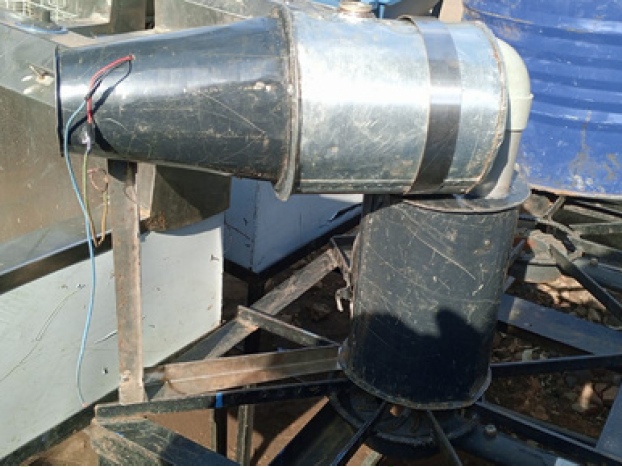
In-progress prototype of hybrid emission control and carbon-capture system created by Wege Prize 2026 semifinalist team Ecoscrubber
Ecoscrubber is creating a hybrid emission control and carbon-capture system designed to eliminate toxic pollutants and greenhouse gases from incinerators while transforming captured residues into valuable construction materials.
Repel is transforming pineapple peel waste into an eco-friendly mosquito repellent that reduces malaria transmission while addressing the growing challenge of organic waste mismanagement in malaria-prone regions.
UniThread EcoHusk is reimagining discarded cocoa husks—which degrade soil and harbor pests and disease when left to rot—as raw materials for activated charcoal-based purification kits that can keep 95% of textile dye pollution out of water and wastewater streams.
Trend 2: Making Circular Systems Replicable
Other semifinalist teams are focusing beyond a single product or service that fits within a circular economy and creating broader, systems-based solutions that respond to localized need but could be replicated in other parts of the world:
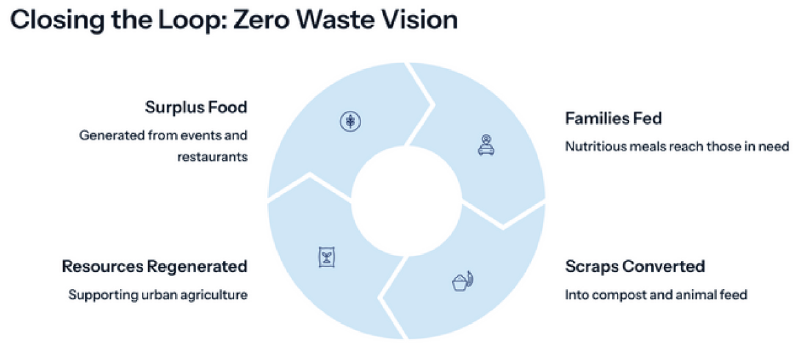
Partial illustration of the surplus food redirection network proposed by Wege Prize 2026 semifinalist team AUAF: Zero Waste, Zero Hunger
AUAF: Zero Waste, Zero Hunger is creating a network to redirect surplus edible food in Afghanistan to food-insecure communities while transforming inedible food into compost, bioenergy, or animal feed.
Eco-Village is constructing affordable, sustainable homes using eco-bricks, solar power, and borehole water coupled with an accessible “subscription pricing model” bundling rent, utilities, and services.
Egret Pads is turning banana stems into affordable, biodegradable sanitary pads for women in Rwanda's low-resource communities, creating dignified access to menstrual health through a circular system that empowers women, supports farmers, and returns used pads back to the soil as fertilizer.
Trend 3: Focus on Food
In the midst of what the UN World Food Program has identified as the largest global food crisis in modern history, other semifinalist teams are focused on increasing efficiency and maximizing impact by boosting soil health, reinventing farming practices, and making more food available to more people:
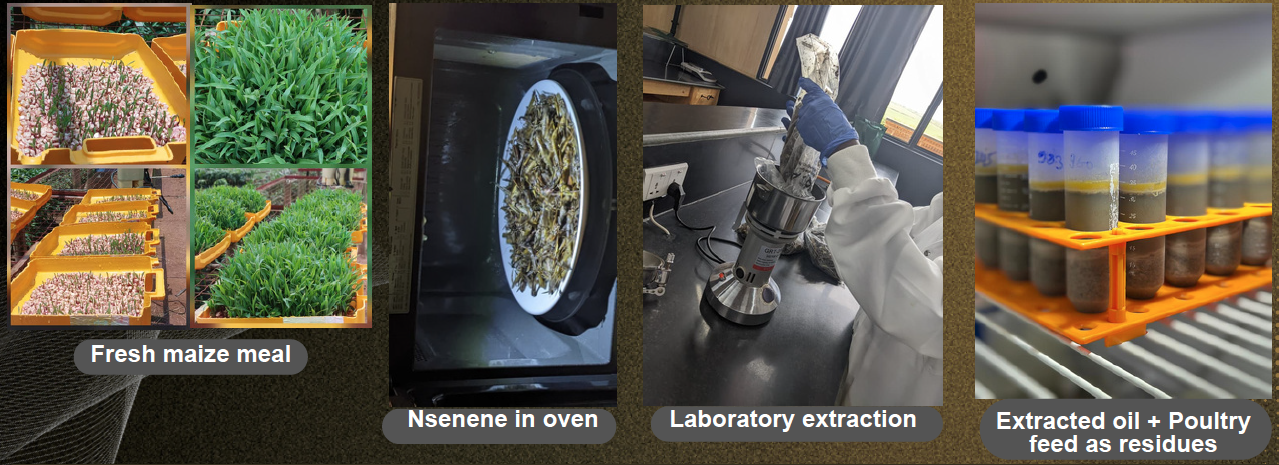
Partial detail of the edible grasshopper harvesting and production process proposed by Wege Prize 2026 semifinalist team Agri Nova
Agri Nova is addressing seasonal limitations of harvesting edible grasshoppers— an increasingly vital and culturally significant protein source, especially in parts of the world with food insecurity—by developing modular, low-impact farming units that adapt to local conditions and enable year-round production.
AgriLoop is formulating a biodegradable hydrogel to boost soil moisture retention (without relying on problematic synthetic interventions) using waste byproducts from cassava, maize, and sugarcane.
Golden Wool is crafting fertilizer pellets from two abundant waste streams in Zimbabwe—sheep’s wool and maize cobs—that reverses the harmful effects of using chemical fertilizers for many years.
DeBruyn also points to the economic accessibility of Wege Prize as a key part of its recipe for impact: The competition does not charge any application or participation fees, leading to more student teams working on solutions in areas where the need is greatest.
“In this way, we have students from around the world getting involved and bringing truly innovative ideas that reflect their drive to be change agents in their own communities and beyond,” says DeBruyn. “These smart, enterprising participants also benefit from working with our judges, who bring vast experiences in the circular economy, sustainable business operations, design, and the natural environment, helping them all make a real difference in the world.”
This year, the competition’s core judge group selected the 15 semifinalists from a pool of 30 teams previously selected to move on to the second of the competition’s four distinct phases. 87 teams in total competed in the first phase. Each semifinalist team has been supported along their journey by extensive feedback from the competition’s diverse expert judges to refine their ideas.
New Judges Added
This year, Wege Prize has enlisted two new core judges, who currently are bringing their knowledge and time to the 15 semifinalist teams: Gretchen Hooker, founder of Pixel Naturalist design studio in Missoula, Montana, as well as Joaquin Viquez, an entrepreneur and founder of Innovaciones Circulares.
In the coming weeks, the Wege Prize core judges will further assess the semifinalist teams’ collaborative work to this point and offer expert guidance as the teams refine their ideas into real-world applications that support the circular economy. Five finalists teams will be selected in mid-March before moving on to present their completed projects during the competition’s final live event on May 15, with the judges then selecting third, second, and first-place winners who will share in Wege Prize’s $65,000 USD pool of cash awards.

Charles Otieno Oyamo of Wege Prize 2025 finalist team AgPress presenting during the 2025 Wege Prize Awards
Wege Prize winners have taken home more than $500,000 in total cash awards since the competition’s onset in 2014, helping advance a circular economy among the multidisciplinary, cultural, and institutional participants.
With insights from the judges’ guidance, many of the teams have advanced their solutions through other incubator hubs and startup funding initiatives, tackling challenges related to the climate, natural environment, energy, social justice, the economy, food, farming, and in other areas.